

A scholarship guide for Nepali students helps you understand the different funding options available to study abroad and how to qualify for them. For many students in Nepal, scholarships are not just helpful they are often essential to manage tuition fees, living costs, and overall expenses.
There are multiple types of scholarships for Nepali students, but they are also grouped into different categories based on funding, eligibility, and purpose. Understanding both is important if you want to find the right opportunity.
With the right strategy and proper guidance, students can significantly improve their chances of securing financial support and making their study abroad journey more affordable.
What Are Scholarships & How Do They Work?
Scholarships are a form of financial aid that help students reduce the cost of studying abroad. Unlike education loans, they do not need to be repaid, making them a valuable resource for many aspiring international students. Depending on the scholarship, they can cover full tuition fees, partial tuition, and in some cases even living expenses, travel, and insurance. Scholarships are typically awarded based on factors such as academic performance, financial need, specific skills or achievements, and sometimes the chosen study destination or field of study.
Types of Scholarships for Nepali Students
Understanding the different types of scholarships is the first step toward finding the right opportunity for studying abroad. Scholarships can vary widely based on academic merit, financial need, funding source, and purpose.
Merit Based Scholarships
These are awarded to students who demonstrate academic excellence. For example, a student with a high GPA and a strong overall academic profile, supported by IELTS, may be eligible for a tuition fee waiver from universities in Australia or the UK. These scholarships reward outstanding academic achievements and motivate students to maintain high performance.
Need Based Scholarships
These are designed to support students who face financial limitations. They usually require proof of family income and focus on students who cannot afford the full cost of international education. By offering financial assistance, need based scholarships help global education more accessible, although availability varies by country and institution
Government Scholarships
These are funded by countries to develop future leaders and build global connections. Recipients are often expected to return to their home country after completing their studies. Some of these scholarships are fully funded but are highly competitive and limited, covering tuition, living expenses, and sometimes travel costs. Popular examples include the Australia Awards (Australian Government), Chevening Scholarship in the UK, and the Fulbright Program in the USA
University Scholarships
These are offered directly by individual institutions to attract promising students. These can be partial or full tuition coverage and are often awarded based on academic profile, early application, or demonstrated potential in a particular field of study.
Subject Specific Scholarships
These are designed for students pursuing specific fields, such as Engineering, IT, Nursing, or Business. These scholarships aim to promote excellence in high demand industries and encourage students to specialize in areas critical to global development.
Country Specific Scholarships
These are country specific scholarships tied to studying in particular destinations.. For instance, certain scholarships are only available for students planning to study in Canada or Australia. These scholarships are often part of a country’s strategy to attract international students and build global connections.
Talent Based Scholarships
They are awarded to students who demonstrate exceptional skills in areas like sports, music, or arts. They provide an opportunity for talented students to use their abilities to fund their education while pursuing their passions.
By understanding the types of scholarships available, Nepali students can strategically target the opportunities that best align with their academic profile, skills, and career goals.
How Scholarships Work for Study Abroad
In most cases, scholarships follow a structured process:
You apply to a university
You become eligible for scholarships
You submit required documents
The university or organization evaluates your profile
Scholarship is awarded based on ranking or eligibility
Some scholarships are automatic, while others require a separate application.
Eligibility Criteria for Scholarships
To qualify for scholarships for Nepali students, you typically need:
Strong academic performance
English proficiency (IELTS/PTE)
Statement of Purpose (SOP)
Recommendation letters
For need based scholarships:
Financial documents are required
Some scholarships also consider:
Leadership experience
Extracurricular activities
How to Apply for Scholarships from Nepal
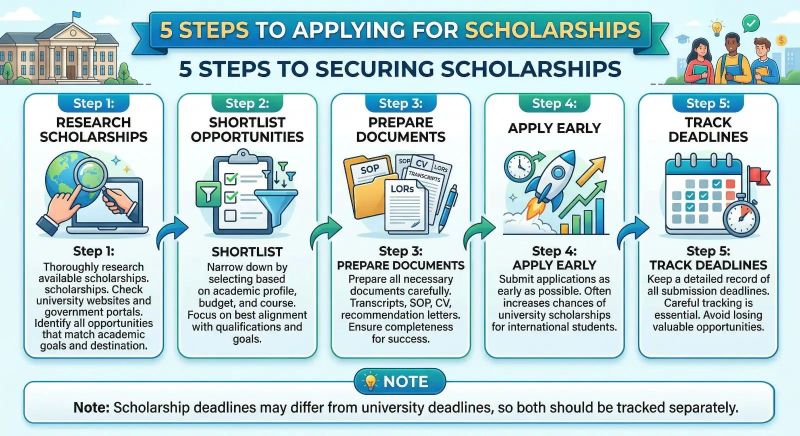
Applying for scholarships from Nepal can be easier if you follow a structured, step by step process. Below are the key steps to improve your chances of success.
Scholarship Success
Consider a Nepali student applying to study in Australia with a GPA of 3.6 and an IELTS score of 7.0. The student applied to five universities and was awarded a 30% scholarship from one university and a 20% scholarship from another. This resulted in significant savings in tuition fees, depending on the university and course costs. This example demonstrates that even partial scholarships can make a significant difference, making studying abroad more affordable and accessible for Nepali students.
Frequently Asked Questions (FAQs)
1. How can Nepali students get scholarships abroad?
Nepali students can get scholarships by maintaining strong academic performance, preparing required documents, and applying early. Applying to multiple universities and scholarships improves success chances significantly.
2. What are fully funded scholarships?
Fully funded scholarships cover tuition fees, living expenses, travel, and sometimes insurance. These are usually offered by governments and are highly competitive.
3. Who is eligible for scholarships?
Eligibility depends on the scholarship type. Most require academic performance, English proficiency, and supporting documents, while some also consider financial need or skills.
4. Can average students get scholarships?
Yes, many universities offer partial scholarships even for average students, especially when combined with a strong SOP and early application.
5. How do scholarships reduce costs?
Scholarships reduce tuition fees and sometimes living expenses, making studying abroad more affordable for students.
Ready to Secure Your Scholarship?
Finding the right scholarship is not just about eligibility. It's about strategy, timing, and proper guidance. Many students miss opportunities simply because they don’t have the right support at the right time.
With over 35 years of experience, 55,000+ successful students, and partnerships with 500+ universities worldwide, Global Reach has built a strong reputation in helping students achieve their study abroad goals. From scholarship identification to application and visa support, structured guidance can make a real difference.
If you’re planning to study abroad, getting expert advice can help you choose the right path, improve your chances of securing scholarships, and avoid costly mistakes. Take the next step toward your international education journey with clarity and confidence.
Contact Global Reach today to start your scholarship application process and explore all the opportunities available for Nepali students.