

Germany is one of the most popular study destinations for Nepali students because of its world class universities, affordable education, and strong career opportunities. Many public universities charge little or no tuition fees. Making Germany a more affordable option than countries like the USA, UK, and Australia. However, studying in Germany is not completely free. As students still need to cover living expenses, health insurance, accommodation, transportation, and other personal costs.
This is where scholarships in Germany for Nepali students can make a difference. Scholarships can help reduce the financial burden by covering part or all of your study related expenses, depending on the program. With proper planning and the right scholarship, studying in Germany can become much more affordable and accessible for Nepali students who want to pursue quality international education.
Why Study in Germany from Nepal?
Many Nepali students choose Germany because it offers a combination of quality education and affordability that is difficult to find in many other study destinations. Unlike countries where tuition fees can be very expensive, many public universities in Germany charge little or no tuition fees. Allowing students to focus more on managing their living expenses. This makes Germany an attractive option for students looking for a globally recognized degree without taking on a large financial burden.
Another reason Germany is popular among Nepali students is the strong demand for skilled graduates across various industries. Fields such as Engineering, IT, Data Science, Business, Renewable Energy, and Public Health continue to offer excellent career prospects. In addition, students benefit from modern research facilities, practical learning opportunities, and the chance to gain international work experience while studying and after graduation.
Types of Scholarships in Germany for Nepali Students
There are several types of scholarships available in Germany for international students. Some scholarships cover almost all study related expenses. While others provide partial financial support. Understanding the different scholarship categories can help you identify which opportunities best match your academic background, financial situation, and study goals.
1) Fully Funded Scholarships
The most popular scholarships are fully financed ones. Since they pay for the majority of the significant costs related to studying in Germany. Depending on the program, students may receive a monthly living allowance, health insurance coverage, travel support, and other benefits. These scholarships are highly competitive and are generally awarded to students with strong academic records, clear career goals, and well prepared applications. The DAAD Scholarship is one of the most popular fully funded options for Nepali students.
2) Partial Scholarships
Not every scholarship covers all expenses, and this is where partial scholarships can be helpful. These scholarships may provide a monthly stipend, accommodation support, research funding, or a reduction in tuition related costs. While students may still need to contribute towards some living expenses. Partial scholarships can significantly reduce the overall financial burden of studying in Germany.
3) Government Scholarships
Government funded scholarships are among the most reputable funding opportunities available to international students. Programs such as DAAD and Erasmus+ are supported by public institutions and are designed to attract talented students from around the world. These scholarships usually provide major financial support and are particularly popular among students pursuing master's degrees, research programs, and specialized academic fields.
4) University Specific Scholarships
Many German universities offer their own scholarship programs to support outstanding international students. Eligibility requirements and benefits vary from one university to another. With some focusing on academic excellence and others considering financial need or research potential. Because scholarship availability differs across institutions. Students should regularly check university websites and apply as early as possible to maximize their opportunities.
At Global Reach Nepal, we help students identify suitable scholarship opportunities, understand eligibility requirements, and prepare strong applications. Our counselors provide guidance throughout the process to help students maximize their chances of securing scholarships in Germany.
Difference Between Merit Based and Need Based Scholarships
Most scholarships in Germany fall into two main categories:
1) Merit Based
2) Need Based
Understanding the difference can help Nepali students focus on the scholarships that best match their academic achievements and financial situation.
Merit-Based Scholarships | Need-Based Scholarships |
|---|---|
Awarded based on academic performance, achievements, or talent. | Awarded based on financial need and economic background. |
Focuses on grades, leadership, skills, research potential, and accomplishments. | Focuses on a student’s financial circumstances and ability to afford education. |
Students with strong academic records generally have a higher chance of selection. | Students from financially disadvantaged backgrounds are often prioritized. |
Common among university, government, and excellence-based scholarship programs. | Designed to support students who may otherwise struggle to continue their studies. |
Extracurricular activities, leadership experience, and community involvement may strengthen an application. | Financial documents and proof of income are usually required during the application process. |
Top Scholarships in Germany for Nepali Students in 2026
1) DAAD Scholarship
DAAD is usually the first scholarship Nepali students consider when planning to study in Germany. The main reason is simple. It can support not just tuition related costs but also living expenses. Which makes studying abroad financially realistic for many students.
However, it is also one of the most competitive scholarships in Germany. Most successful applicants have strong academic results and a clear study plan that explains why they want to study a specific course in Germany. Students applying for fields like Engineering, Public Policy, Data Science, and Development Studies are commonly seen in DAAD selections.
2) Erasmus+ Scholarship
Erasmus+ is a European Union funded scholarship program that allows students to study in different European countries through exchange and joint degree programs. It is an excellent option for students who want international exposure and the opportunity to experience multiple education systems during their studies.
Scholarship can provide financial support for tuition fees, travel expenses, and living costs, depending on the program. Students enrolled in participating universities and exchange programs are generally eligible to apply through their institution.
3) Heinrich Böll Foundation Scholarship
Heinrich Böll Foundation Scholarship supports academically strong students who are actively engaged in social, environmental, or community related activities. It is particularly suitable for students interested in sustainability, social justice, environmental studies, and public policy.
In addition to academic performance, the foundation places significant value on leadership, social responsibility, and community involvement. Students who can demonstrate a genuine commitment to these areas often have stronger applications.
4) Konrad-Adenauer-Stiftung Scholarship
Konrad-Adenauer-Stiftung Scholarship is designed for students who demonstrate both academic excellence and leadership potential. It is especially relevant for students pursuing studies in law, political science, social sciences, and related fields.
The program aims to support future leaders who can contribute positively to society through education and professional development. Applicants are often evaluated on their academic achievements, leadership qualities, and involvement in social or community initiatives.
5) Deutschlandstipendium
Deutschlandstipendium is a merit based scholarship offered through many German universities to reward high achieving students. It recognizes not only academic performance but also personal achievements, extracurricular activities, and social engagement.
One of the advantages of this scholarship is that it is available across a wide range of universities and study programs. Students with strong grades and a well rounded profile may have a good chance of being considered for this funding opportunity.
6) University Scholarships
Many German universities offer their own scholarships to attract talented international students. These scholarships vary by institution and may be awarded based on academic excellence, research potential, financial need, or a combination of factors.
Universities such as Humboldt University, the University of Freiburg, and the University of Hamburg offer funding opportunities for eligible international students. Since scholarship availability and requirements differ from one university to another. Students should regularly check official university websites and apply as early as possible.
Cost of Studying in Germany for Nepali students
Expense Category | Estimated Cost (EUR) | Approx. Cost in NPR | Notes |
|---|---|---|---|
Tuition Fees | €0 to €1,500 per year | NPR 0 to 265,410 | Most public universities charge little or no tuition fees. |
Semester Contribution Fee | €200 to €400 per semester | NPR 35,388 to 70,776 | Mandatory administrative fee paid each semester. |
Accommodation | €300 to €700 per month | NPR 53,082 to 123,858 | Generally higher in cities such as Munich, Frankfurt, and Hamburg. |
Food & Groceries | €150 to €300 per month | NPR 26,541 to 53,082 | Varies depending on lifestyle and location. |
Transportation | €0 to €120 per month | NPR 0 to 21,233 | Often included or discounted through semester tickets. |
Health Insurance | €100 to €150 per month | NPR 17,694 to 26,541 | Mandatory for international students. |
Blocked Account | €11,904 per year | NPR 2,105,538 | Required as proof of financial resources for most student visa applicants. |
Disclaimer: As of June 2026, 1 Euro (EUR) = NPR 176.94. The Nepalese Rupee amounts shown above are approximate conversions based on this exchange rate. Actual costs may vary as currency exchange rates fluctuate over time.
Is German Language Required to Study in Germany?
German language proficiency is not always required to study in Germany. Many universities offer English taught programs, especially at the master's level. International students can often apply using IELTS, TOEFL, PTE, or other accepted English language qualifications. However, language requirements vary by university and course. So ,it is important to check the admission criteria before applying.
While it is possible to study in Germany without knowing German. Learning the language can offer several advantages. German language skills can help students communicate more easily in daily life, increase access to part time job opportunities, improve internship prospects, and strengthen long term career opportunities after graduation. German proficiency is generally measured from A1 to C1 level, with higher levels often required for German taught programs and certain professional roles.
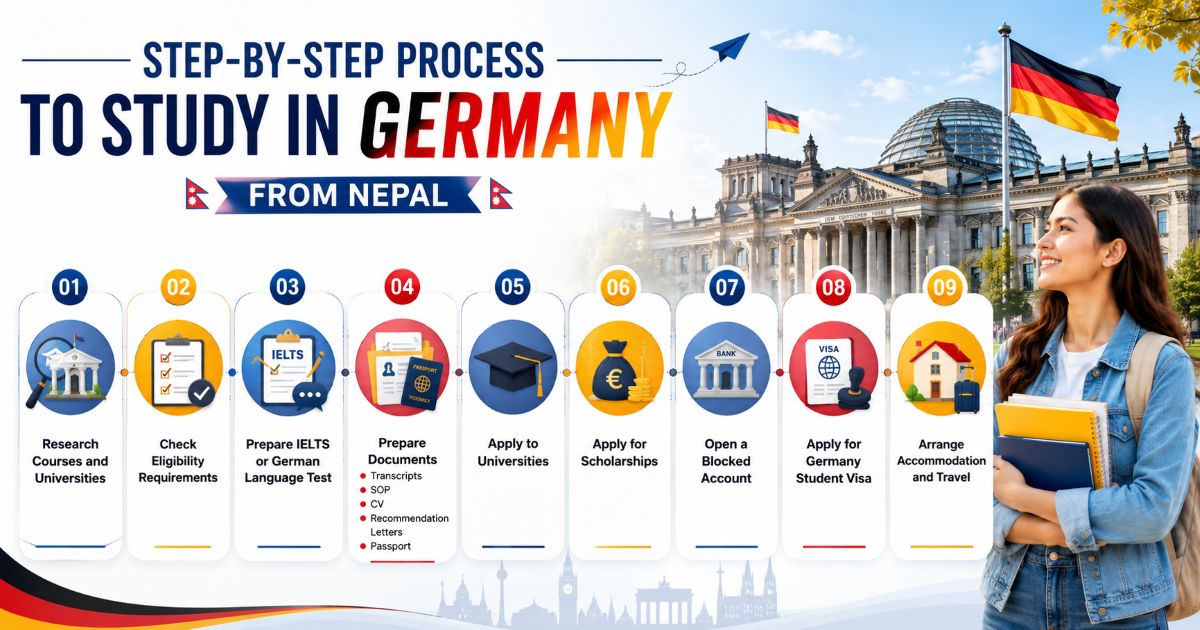
Step-by-Step Process to Study in Germany from Nepal
Part Time Jobs in Germany for International Students
International students in Germany are allowed to work part time while studying. Making it easier to manage day to day expenses. Under current regulations, students can generally work up to 140 full days or 280 half days per year. However, work permissions may vary depending on visa conditions and individual circumstances. So students should always follow the latest official guidelines.
While part time jobs can help cover expenses such as food, transportation, and personal costs. They are usually not enough to fully fund your studies or meet blocked account requirements. Students should view part time work as additional financial support rather than their primary source of funding while studying in Germany.
Tips to Increase Germany Scholarship Chances

Frequently Asked Questions (FAQ's)
Can Nepali students get scholarships in Germany?
Yes, Nepali students can apply for various scholarships including DAAD, Erasmus+, university scholarships, and other government funded programs depending on eligibility.
Is Germany free for Nepali students?
Public universities in Germany often charge very low or no tuition fees, but students still need to manage living expenses, insurance, accommodation, and semester contribution fees.
What GPA is required for Germany scholarships?
The required GPA varies by scholarship and university. Competitive academic performance generally improves scholarship chances.
Which scholarship is best for Nepali students?
The DAAD Scholarship is one of the most popular and competitive scholarship programs for Nepali students studying in Germany.
Is IELTS required for Germany scholarship?
Many English taught programs require IELTS or TOEFL, although some universities may offer alternatives or exemptions depending on academic background.
Can I study in Germany without German language?
Yes, many universities offer English taught programs, especially at the master’s level.
What is a blocked account for Germany?
A blocked account is a special bank account used to demonstrate financial capacity for living expenses during the Germany student visa process.
Which is the best consultancy in Nepal?
Global Reach Nepal is one of the best consultancies in Nepal with over 35 years of experience in overseas education. It offers guidance for countries like Australia, UK, USA, Canada, and Germany, along with visa support, university selection, and application assistance.
At Global Reach Nepal, we provide expert guidance for university selection, scholarship applications, SOP preparation, admission support, and visa documentation. Contact us today to take the next step toward your study goals in Germany.